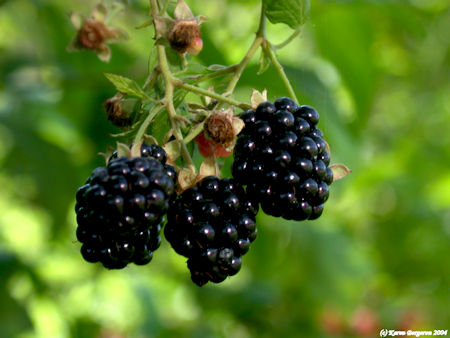
Blackberry
Rubus allegheniensis
Other Names : Allegheny Blackberry, American Blackberry, Bly, Bramble, Bramble-Kite, Brambleberry, Brameberry, Brummel
A favorite summertime treat, Blackberries have some mean thorns so wear gloves and long sleeves when harvesting. Wild Blackberries and Black Raspberries make great cobblers, pies, and jellies but are so good straight from the vine it's hard not to eat them on the spot.
Blackberry Edible and Herbal Use
The Blackberry plant is edible, and also used as an herbal remedy. Blackberry leaf is more commonly used as a remedy, but the root is also valued. Young edible shoots are harvested in the spring, and can be peeled and used in salads.
The root-bark and the leaves are said to be astringent, depurative, diuretic, tonic and vulnerary. Blackberry is said to be excellent alternative medicine for dysentery, diarrhea, hemorrhoids, and cystitis.
The most astringent part of the Blackberry plant is the root. Orally, they are used to treat sore throats, mouth ulcers and gum inflammations. A decoction of the leaves is useful as a gargle in treating thrush and also makes a good general mouthwash. The presence of large amounts of tannins that give blackberry roots and leaves an astringent effect useful for treating diarrhea are also helpful for soothing sore throats. A herbal syrup is also made from Blackberry, using the fruit and root bark in honey for a cough remedy.
Blackberry Native Habitat and Description
Blackberry is a perennial thorny shrub or vine that is native to Eastern N. America from Nova Scotia to Ontario, New York, Virginia and North Carolina south. It is found in dry thickets, clearings and woodland margins, fence rows, open meadows, roadsides in and waste places.
When the Blackberry flowers bloom in the wild, it is a beautiful sight. Hillsides and fields are covered with white flowers. The flowers have five petals, and bloom in April and May. Blackberry plants have biennial stems. They produce a number of new stems from the perennial rootstock each year. The stems fruit in their second year and then die. The vines are long and very thorny, growing in groups or thickets. Blackberry vines branch and can grow up to 15 feet or more in length, and thickets can extend to hundreds of square acres in an area. They die off after 2 to 3 years but are usually retained in the thickets making them largely impenetrable. Blackberry Leaves are light green, serrate and palmate with 3 to five leaflets or fingers, the main vein on the back of each leaflet has thorns.
How to Grow Blackberries
Blackberry is easily grown in a good well-drained loamy soil in sun or semi-shade.
Blackberry History and Folklore
Blackberries were in olden days supposed to give protection against all ’evil runes,’ if gathered at the right time of the moon. Since ancient Greek physicians prescribed the herb for gout, the leaves, roots, and even berries have been employed as an herbal remedy. The most common uses were for treating diarrhea, sore throats, and wounds. Native Americans made fiber, obtained from the stem, it was used to make a strong twine. Another use was as a huge barricade around the village, made of piles of the thorny canes, for protection from 4 and 2 legged predators. A purple to dull blue dye is obtained from the fruit.
Blackberry Harvesting Information
Blackberries usually ripen in late June through July. Gather edible fruit when when they are dark purple. Unripe fruit is sour. Blackberries can be frozen or canned for later use. Gather leaves and roots of young (first year) cane, and dry for later herbal use.
Blackberry Recipe Ideas
Blackberry Leaf herb tea:
To 1 ounce of the dried Blackberry leaves and root bark, add 1 pint of boiling water, and steep 10 minutes. Drink a tea cup at a time. Use Blackberry fruit to make jellies, jams, cobblers, and in any recipe where you would use raspberries.
Article by Deb Jackson & Karen Bergeron
More Blackberry Links
Disclaimer
The herbal information on this web site is intended for educational purposes only. It is not the intention of the editor to advise on health care. Please see a medical professional about any health concerns you have. These statements have not been evaluated by the FDA. The information on this web site is not intended to prevent, diagnose, treat, or cure any disease.