Wild Carrot
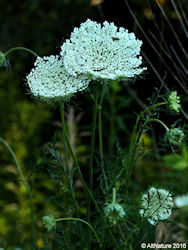
Daucus carota
Queen Anne’s Lace is the wild progenitor of our cultivated carrot. It still has many of the properties lost in cultivation. If an apple a day will keep the Doctor away, legend has it that a wild carrot a day might keep death itself away.
Other Names: Queen-Anne’s lace, Bees’ Nest, Bird’s Nest, Carrot, Carotte, Carrot, Wild Carrot, Yarkuki, Zanahoria Wild Carrot, Birds Nest Weed, Devils Plague, Garden Carrot, Bee’s nest plant, Bird’s nest root
Wild Carrot Herbal Uses
Wild Carrot is edible, as well as a useful herb. The root is edible cooked or raw, the flower clusters can be french-fried for a carrot-flavored, attractive dish. The aromatic seed is used as a flavoring in stews and soups.
Caution: Not safe for use by pregnant women.
Wild Carrot, or Queen Anne's Lace, has been used for centuries in herbalism. An infusion is used in the treatment of various complaints including digestive disorders, (as it soothes the digestive tract), kidney and bladder diseases and in the treatment of dropsy. It supports the liver, stimulates the flow of urine and the removal of waste by the kidneys. As a cleansing herbal remedy, an infusion of Wild Carrot leaves has been used to counter cystitis and kidney stone formation, and to diminish stones that have already formed. The seeds can be used as a settling carminative agent for the relief of flatulence and colic.
Wild Carrot leaves contain significant amounts of porphyrins, which stimulate the pituitary gland and lead to the release of increased levels of sex hormones, and stimulates the uterus. The plant is also used to encourage delayed menstruation, can induce uterine contractions and so should not be used by pregnant women. The seed is a traditional ’morning after’ contraceptive and there is some evidence to uphold this belief. An essential oil obtained from the seed has also been used cosmetically in anti-wrinkle creams. A strong decoction of the seeds and root make a very good insecticide.
. Wild Carrot has been used as a herb for thousands of years as an anthelmintic, carminative, contraceptive, deobstruent, diuretic, emmenagogue, galactogogue, ophthalmic, and stimulant.
 Wild Carrot Habitat and Description
Queen Anne's Lace is a biennial herb, originally a native of Southern Europe. It has become naturalized throughout the United States and Canada.
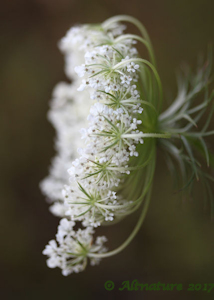
In its second year, from a taproot, the erect and branched carrot stems grows to a height of two to four feet or more. Both stems and leaves are covered with short coarse hairs. The leaves are very finely divided-tri-pinnate, alternate, and embrace the stem with a sheathing base. The two to four inch "flower" is actually a compound of terminal umbels, made up of many small white flowers. The central flower of the Umbelliferae is often purple. A ring of finely-divided and leaf-like bracts grows at the point where the umbel meets the stem. Wild Carrot blooms from June to August, but often continues much longer. Its root is small and spindle shaped, whitish, slender and hard, (tender when young), but soon gets tough, with a strong aromatic smell.
Growing and Harvesting Wild Carrot
Wild Carrot is easy to grow, it prefers a sunny position and a well-drained neutral to alkaline soil. Considered an obnoxious weed by some, it can spread very quickly. Cultivation is not advisable. It's almost always found in any old field.
Harvest entire plant in July or when flowers bloom, and dry for later herb use. Collect edible roots and shoots in spring when tender. Gather seed in fall.
Wild Carrot History and Folklore
The name ’Carrot’ is Celtic, and means ’red of color,’ and Daucus from the Greek dais to burn, signifying its pungent and stimulating qualities. An Old English superstition is that the small purple flower in the center of the Wild Carrot was of benefit in curing epilepsy.
Article by Deb Jackson, Edited by Karen Bergeron
Disclaimer
The herbal information on this web site is intended for educational purposes only. It is not the intention of the editor to advise on health care. Please see a medical professional about any health concerns you have. These statements have not been evaluated by the FDA. The information on this web site is not intended to prevent, diagnose, treat, or cure any disease.