Greek Valerian
Polemonium reptans
Other Names: Abscess Root, Blue Bells, Jacob's Ladder, Creeping Jacob's Ladder, False Jacob's Ladder, Greek Valerian, Onechte Jacobsladder, Polemonie Fausse, Sweatroot
Greek Valerian Herb Use
The following information is based on historical uses found in herbal lore and unscientific claims. There is insufficient research on this herb to prove benefits or safety issues it may have in humans.
Greek Valerian is rarely used today for alternative medicine. The roots are alterative, astringent, diaphoretic, expectorant and pectoral, and can be taken as an infusion with water or as a herbal tincture for coughs, colds, bronchitis, laryngitis, tuberculosis, feverish and inflammatory diseases, including abscess and skin conditions. A decoction of the whole plant is used as a hair rinse.
Greek Valerian Habitat and Description
Greek Valerian is a perennial native herb found growing in rich woods, damp ground and along shady river banks in Eastern N. America from New York to Minnesota, south to Kansas and Georgia.
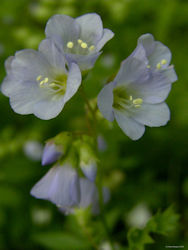
Greek Valerian flowers bloom from March to May. The nodding, blue to purple flowers grow in loose, terminal clusters. The leaves form a rosette at the base, and grow in alternate pairs on the stem, they are pinnate with six to eight opposite pairs of leaflets. Greek Valerian has slender, creeping roots, and can multiply very quickly. The stems are multiple as many as 10 to one plant they are branched and grow to 12 inches high.
How to Grow Greek Valerian
Greek Valerian is easily cultivated from seed or root division, it prefers moist, well drained, sandy soil in a shady position. Gather roots in fall, whole plants in spring. Dry for later herb use. The flowers are edible, taste good in salad.
Greek Valerian History and Folklore
Formerly used internally in the treatment of a wide range of conditions ranging from headaches to fevers and epilepsy-Culpepper says of it:
'It is under Mercury, and is alexipharmic, sudorific, and cephalic, and useful in malignant fevers and pestilential distempers; it helps in nervous complaints, headaches, trembling, palpitations of the heart, vapours, etc. It is good in hysteric cases, and epilepsies have been cured by the use of this herb.'
Because Greek Valerian has a smell that attracts cats it was believed by witch hunters to be planted only by witches for the pleasure of their familiars. It was also used for the bites of venomous snakes and insects.
Herbal Tea Recipe
Infusion: Add 1 tsp. dried root to 1 cup water steep for 10 min. take in tbls. doses throughout the day, for coughs, colds, congestion.
Article by Deb Jackson & Karen Bergeron
Disclaimer
The herbal information on this web site is intended for educational purposes only. It is not the intention of the editor to advise on health care. Please see a medical professional about any health concerns you have. These statements have not been evaluated by the FDA. The information on this web site is not intended to prevent, diagnose, treat, or cure any disease.