Jack-in-the-Pulpit
Arisaema triphyllum
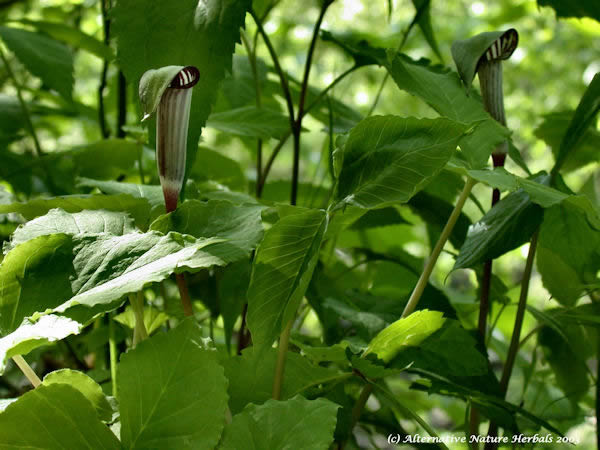
Other Names: Indian Turnip, Wild turnip, arum, three-leaved arum, dragon-turnip, brown dragon, devil’s-ear, marsh turnip, swamp turnip, meadow turnip, bog onion, priest’s-pintle, lords-and-ladies.
Jack in the Pulpit Native Habitat and Description
Jack in the Pulpit is a native perennial herb found in moist woods from Canada to Florida and westward to Kansas and Minnesota. The leaves, one or two, are long stemmed, smooth, light green, trifoliate, and entire. Each leaflet is ovate from 3 to 6 inches long and from 1 1/2 to 3 1/2 inches wide. The root is a corm, it is shaped like a turnip.
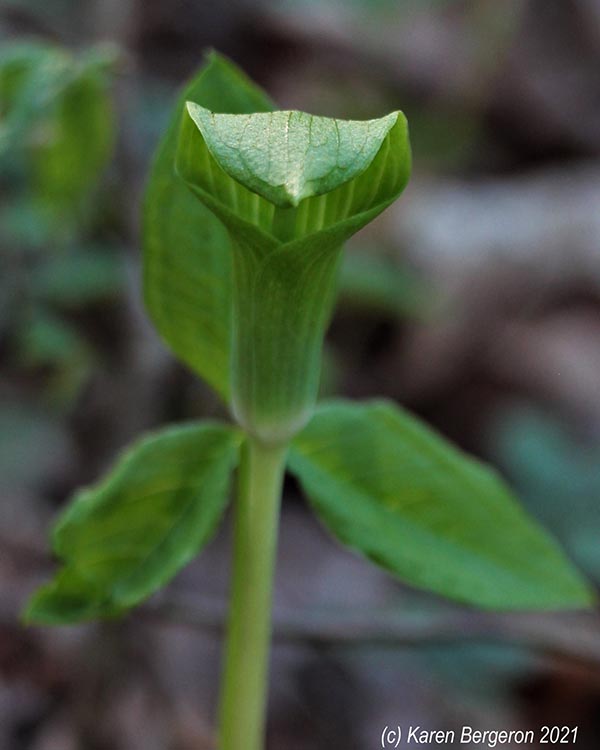
Jack in the Pulpit flowers bloom in April and May. The single flower is either all green or green with dark purple stripes, is an unusual formation, a sort of green vase, a spathe, made from a single leaf, with a stalk growing up the middle of it, and a leaf-hood folding gracefully over its top.
Jack-in-the-Pulpit stands about 6 inches to 1 1/2 feet tall. In autumn the rest of the plant dies away, leaving only the berry-covered stalk. The fruit ripens in the form of a bunch of bright, scarlet, shining berries. Jack in the Pulpit plant starts life as a male plant. After 2 years, or longer in poor soil, it turns female, flowers and bears seed. If the plant receives a shock, it may turn back male again.
Cultivation is said to be very difficult and usually requires green house conditions.
Jack in the Pulpit Herbal Use
Caution is advised as ingesting the fresh root can cause poisoning and even death. Plants with oxalates shoould be avoided by people prone to kidney stones.
WARNING: Raw corms are not edible and contain calcium oxalate which will cause a burning sensation in the mouth.
Jack-in-the-Pulpit root has been used in alternative medicine and is considered edible only after drying for several months then cooking. The fresh root contains high concentrations of calcium oxalate and is considered to be too dangerous and intensely acrid to use.
Roasting the root after drying it 6 months is said to remove the acridity. The roots can be cut into very thin slices and allowed to dry after which they are eaten like potato chips, crumbled to make a cereal or ground into a cocoa-flavored powder for making biscuits and cakes. It should not need to be said that if it burns your mouth, don't eat it.
Read more about Jack in the Puplit edibility at Eat the Weeds
A starch obtained from the roots of Jack in the Pulpit is used as a stiffener for clothes.
Jack in the Pulpit root is acrid, antiseptic, diaphoretic, expectorant, irritant and stimulant. A poultice of root was historically used for headaches and various skin diseases. An ointment was used for ringworm, tetterworm and abscesses treatments. Jewelweed is a much safer option for skin problems.
Jack in the Pulpit History and Folklore
The root was used as a contraceptive by the women of some Native American tribes. Considering the burning that oxalic acid causes on mucus membranes, I wonder if it sent their lovers away screaming with pain?
After drying the root for several months, Native Americans peeled and ground Jack in the Pulpit roots to powder to make a bread, which has a flavor similar to chocolate. The berries were used to make a red dye.
Article by Deb Jackson, my good friend and mentor who passed away in 2019.
Edited and updated by Karen Bergeron on May 17, 2021.
Disclaimer
The herbal information on this web site is intended for educational purposes only. It is not the intention of the editor to advise on health care. Please see a medical professional about any health concerns you have. These statements have not been evaluated by the FDA. The information on this web site is not intended to prevent, diagnose, treat, or cure any disease.