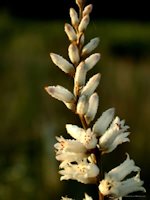
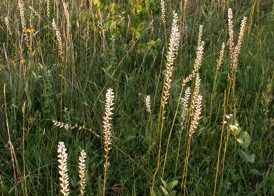
wildflower with
grass like leeaves.
Aletris Farinosa Herb
Other Names:
Star grass, Colic root, True Unicorn Root, Ague Root
Aletris Herb Uses
Aletris Herb Summary
- Used as a herbal remedy for "female complaints".
- Moderate Toxicity
- Rare Plant, Cultivation is difficult. Do not wildcraft!
Aletris has a history of use as an herbal remedy for female complaints. As an anodyne, It is said to tone the uterus, calm the stomach, and may have narcotic properties. Avoid use in pregnancy and when breastfeeding. No known interactions or contraindications exist, but Aletris may have estrogenic properties and should be avoided when estrogen is contra-indicated.
Chemical Constituents include- Alkaloids, Diosgenin, Saponin
From DUKE1992A: Duke, James A. 1992. Handbook of phytochemical constituents of GRAS herbs and other economic plants. Boca Raton, FL. CRC Press.
Aletris Farinosa Habitat and Description
Aletris Farinosa is a slow growing perennial in the Lily family.
Also known as True Unicorn Root, it grows wild in bottom land,
moist soil; and full sun to part shade, such as the edges of
wooded areas in Eastern United States. Aletris first presents as
a starburst of basal, grass like leaves, sending up spikes that boast small
white flowers from April to July. This native herb is no longer
common due to habitat destruction; and should not be harvested in
from the wild.
Detailed Aletris Description - Go Botany External Site.
How to Grow Aletris Farinosa
Aletris can be grown from root divisions and in my opinion is a good candidate for plant rescue. Serious attempts at cultivation are needed if this plant is to be sustainable for herbal use. Aletris likes well drained, sandy soil with full sun at least six hours a day. Aletris doesn't compete well with other plants.
Cultivation information from NC State Extension - Aletris Farinosa
It is reported to take two years in a greenhouse from seed, one grower said it died as soon as he transplanted it to the outdoors. Frankly that is the only person I found who reported anything about growing this plant. That does not mean it cannot be propagated. If you have information on sources of cultivated Aletris Farinosa root cuttings, please email karen@altnature.com
Seed Germination
Database - Perennials
"Sow at 20C (68F),
germinates in less than two weeks".
Possibly unsustainable due to habitat destruction.
Dilemmas of
Traditional Botanical Research HerbalGram and the Botanical
Medicine Academy
Aletris Farinosa History and Folklore
Keeps evil at bay when sprinkled around home or worn as
sachet.
Cunningham's
Encyclopedia of Magical Herbs
The scientific name is from the Greek word Aletris "a
female slave who grinds corn" and farinosa
"mealy". Wildflowers
of Tennessee, the Ohio Vallery and Southern Appalachians - Dennis
Horn
Sources
Books
Wildflowers of Tennessee, the Ohio Vallery and Southern
Appalachians - Dennis Horn
Indian Herbology of North America - Alma Hutchens Out of Print, used copies on Amazon.com
The Herb Book by John Lust Covers almost 500 herbs, including many native species, as well as recipes for many herbal concoctions. A wealth of information in an inexpensive paperback edition.
Web sites used for Research
Visit them for more information
about Aletris Farinosa
Henriette’s
Herbal - Aletris
The "First Lady of Herbs on the
Internet" has tons of herbal information and photos on her
web site.
Aletris -
Drugs.com
Includes information from a medical standpoint,
uses, contraindications, chemical constituents.
THE HERB HUNTERS GUIDE AMERICAN MEDICINAL PLANTS OF COMMERCIAL IMPORTANCEBy A.F. SIEVERS, Senior Biochemist, Office of Drug and Related Plants, Bureau of Plant Industry
Photos by Karen Bergeron (c) 2002 -2021
Article
(c) 2007 by Karen Bergeron Updated 02/06/2021