Educating about Medicinal Herb Plants Online since 1997


Learn about herbs, medicinal plants, herbal remedies and uses, with hundreds of color herb pictures.

Alternative Nature Online Herbal

Promote Your Page Too

 
Tephyr's
Co-Creative Gardening

Pages

Add AltNature
Online Herbal
to your Favorites


Bloodroot   
Sanguinaria canadensis

Other Names:  Coon root, Indian paint, Red Puccoon,  Red root, Tetterwort
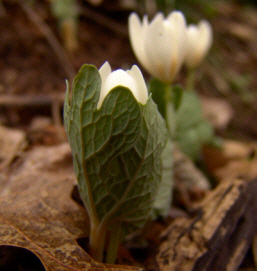
 

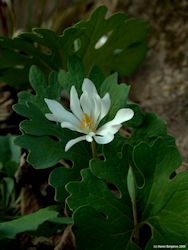
bloodroot herb flower picture copyrighted bloodroot herb flower emerging from leaf

 Bloodroot herb pictures by Karen Bergeron  Copyright 2006. Permission required to use any herb pictures from this site. 
High Resolution Herb Stock Photos click here   Free Herb Pictures for web sites, click here


Bloodroot Herb Use and Medicinal Properties

Bloodroot is used in herbal medicine in very small doses, mainly for bronchial problems and severe throat infections. The root is used in many pharmaceuticals, mixed with other compounds to treat heart problems, dental applications (to inhibit plaque), and to treat migraines. Bloodroot paste is used externally for skin diseases, warts, and tumors. For ringworm apply the fluid extract. Bloodroot is said to repel insects. The root is used in as an anesthetic, cathartic, emetic, emmenagogue, expectorant, diuretic, febrifuge, sedative, stimulant and tonic.

Research is very promising for Bloodroot constituents. One is sanguinarine; it is showing results as an anesthetic, antibacterial, anti-cholinesterase, anti-edemic, anti-gingivitic, anti-inflammatory, anti-neoplastic, antioxidant, anti-periodontic, anti-plaque, antiseptic, diuretic, emetic, expectorant, fungicide, gastrocontractant, hypertensive, pesticide, respiratory stimulant and more. Another important constituent is Berberine (also found in Goldenseal, Oregon Grape and Honeysuckle) which is showing promise in fighting brain tumors and many other cancers. CAUTION Use internally with caution, it contains toxic opium-like alkaloids and can cause mucous membrane irritation, an over dose can be fatal, do not use when pregnant or lactating. Bloodroot is not edible.

Click here to visit a site where people who have used Bloodroot for skin growth share their experiences.

Bloodroot Habitat and Description

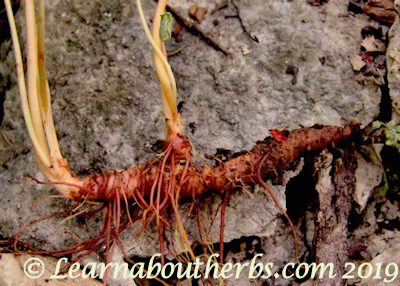
Bloodroot is a North American native perennial herb found growing in shaded, moist, rich woodlands from Quebec south to Florida and west to Kansas. Bloodroot grows to about 6 to 7 inches tall.  The pale green, palmate, lobed, basal leaf is wrapped around the flower as it emerges and opens as the flowers blooms. The stem of Bloodroot is round, often orange or red when mature, it is topped by a single white flower with 8 to 12 petals and bright yellow center. The root is a thick, tender, tuber which contains a red juice that stains the skin readily. Gather root when flowers are in bloom. Dry the roots for later use or tincture fresh. Bloodroot is endangered and should be cultivated. Do not harvest from the wild.
How to Grow Bloodroot

Cultivate Bloodroot from seed or root cuttings, prefers light, sandy, moist soil, slightly acidic, shady areas. Bloodroot takes easily to cultivation in shady areas. Plants can be found from ethical cultivators. Again, do not take Bloodroot plants from the woods.

Buy Bloodroot plants from Easyliving Wildflowers

Herbal Recipes

Dye: Mix 4 tbs. fresh Bloodroot juice in 1 gal. cold water, add 1 tbs. alum as mordant. This preparation will work on most material to achieve a red to orange hue. Wear gloves when handling bloodroot.

History and Folklore

Bloodroot was used as a medicinal herb extensively by the Indian Medicine Men and Women in some North American tribes. It was also a ritual skin paint, or war paint, and used as dye by others. The red juice expressed from the root makes an excellent die for cloth, yarn, and many other materials and can be used as a wood stain.
Bloodroot Links

Wildflowers of North Carolina
http://www.ncnatural.com/wildflwr/blodroot.html

Wildflowers of the Southeastern US
http://2bnthewild.com/plants/H261.htm

The North Carolina Arboretum - Bloodroot
(Superb Herbs: 10 medicinal herbs with economic promise)


Article by Deb Jackson & Karen Bergeron

Next > Blue Cohosh


Alternative Nature Online Herbal
Copyright © 1997 - 2011. All Rights Reserved by Alternative Nature Enterprises.
Editor Karen Bergeron
AltNature Herbals  P.O. Box 93 Erin, TN 37061
Please use email for questions about herbs.  Email karen@altnature.com

Medicinal Herb Uses, Pictures and Descriptions    Browse 500+ Herb Pictures  Herb Farming  |  Herb and Alternative Medicine ArticlesGinseng Information  | Poison Ivy Pictures Herbal Links
 Contact | Privacy Policy | Store | Advertising | Blog  | Facebook Page


 The herbal information on this web site is intended for educational purposes only. It is not the intention of the editor to advise on health care. Please see a medical professional about any health concerns you have.  Disclaimer - These statements have not been evaluated by the FDA.  The information on this web site is not intended to prevent, diagnose, treat, or cure any disease.

This information is intended as an introduction to how medicinal herb plants are used. It is intended for educational purposes only. I am not a medical professional and I cannot prescribe what herbs are right for you. I cannot answer medical questions, so please do not ask me (or any other complete stranger for that matter) to prescribe herbal cures, treatment or to guess what is wrong with you.

If you use herbs, do so responsibly. Consult your doctor about your health conditions and use of herbal supplements. Herbs may be harmful if taken for the wrong conditions, used in excessive amounts, combined with prescription drugs or alcohol, or used by persons who don't know what they are doing. Just because an herbal remedy is natural, does not mean it is safe! There are herbs that are poisonous such as Poison Hemlock, Jimson weed, and many more.

I will be happy to help you ID wild plants that you find, or help you locate herbs, plants or herb seeds and especially pictures.
email
karen@altnature.com

Amazing Jewelweed Remedies
Herbal Remedy for Poison Ivy, Oak and other skin condition