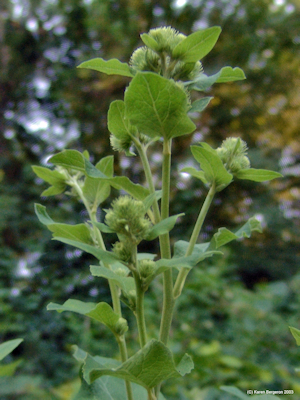
Burdock Herb
Articles and Photos Copyright Karen Bergeron 2007-2020
Arctium lappa, - Great Burdock
Arctium Minus - Lesser Burdock
Also Known as Cocklebur, Gobo root, Clot bur, Burr Seed
Burdock Habitat and Description
Common burdock is a member of the Aster or Sunflower family, the Thistle tribe. Burdock, a biennial herb with that reproduces from its prickly seeds is a common wild plant commonly found in pastures and waste places in the Eastern Central United States, as far south as Tennessee - though more common northward, also in Canada.
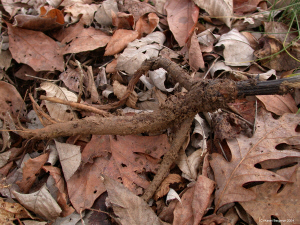
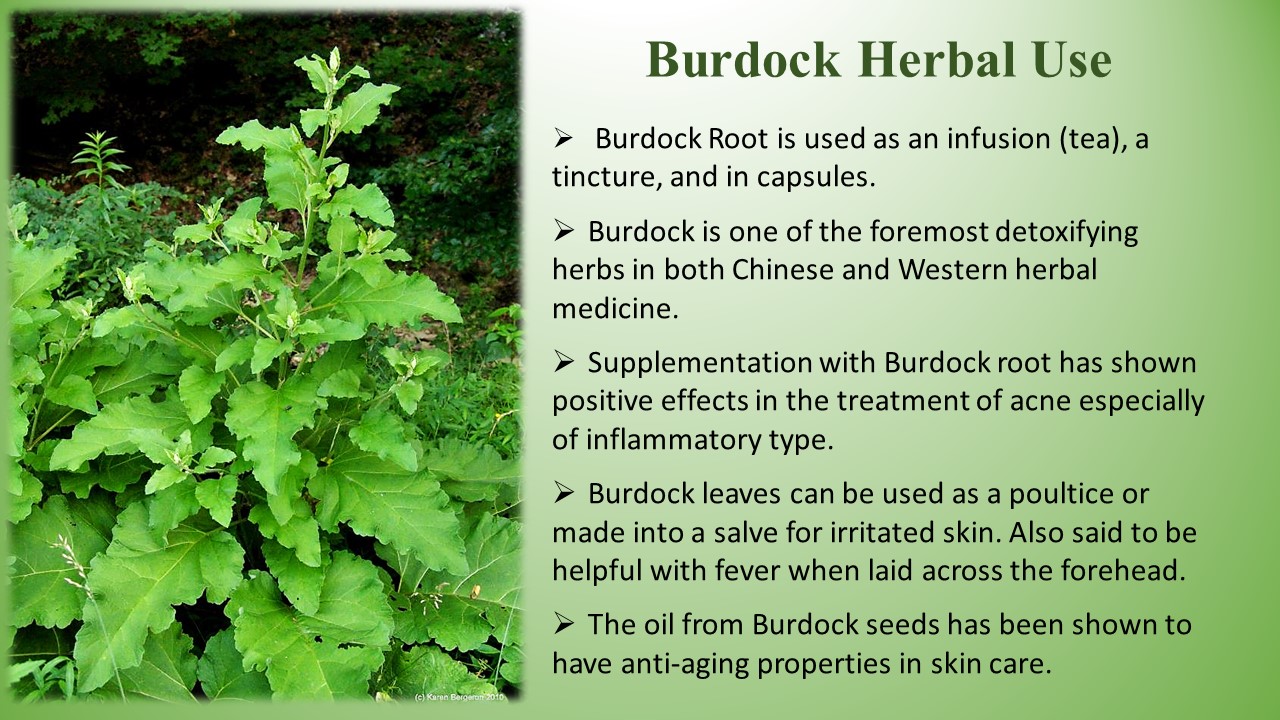
First year Burdock plants have large leaves that resemble Elephant ears but lay prostrate on the ground (basal leaves in a rosette). Do not confuse with Rhubarb, whose leaves are poisonous.
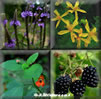
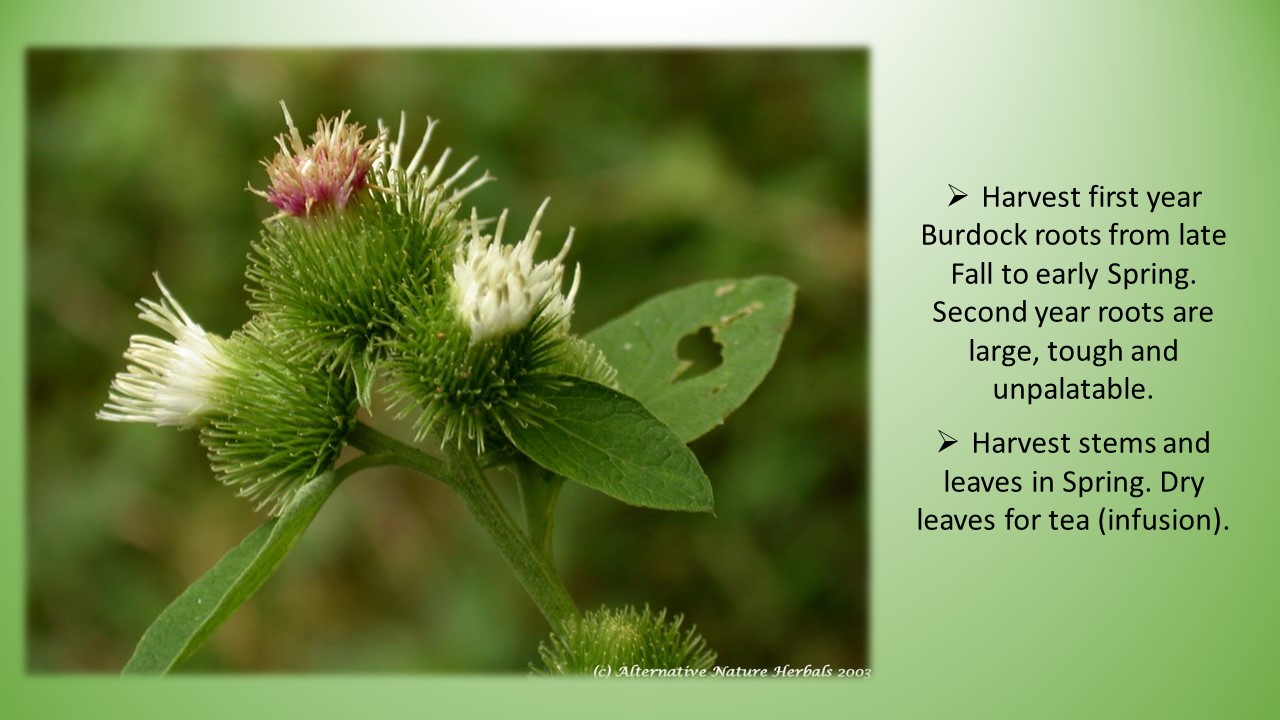
In the second year, Burdock sends up an erect stem and boasts round pink and white or purple flowers in early summer, then ripens into prickly balls up to an inch in diameter. The head is enclosed in a prickly bur composed of numerous smooth or woolly bracts tipped with hooked spines, flowering July to October. The stout, grooved, rough stem has multiple branches, and grows to 2-6 feet tall. The leaves are alternate, dark green, smooth above, whitish green, and woolly-hairy beneath.
People who are unaware of its use as food and medicine consider Burdock to be a weed, and a pesky one at that. The ripe seeds cling to clothing and animal fur, and aren't always easy to remove. I spent many an hour as a youngster combing cockleburs from the fur of our dogs and horses, and writing them off as minor nuisance.
Printable Slides
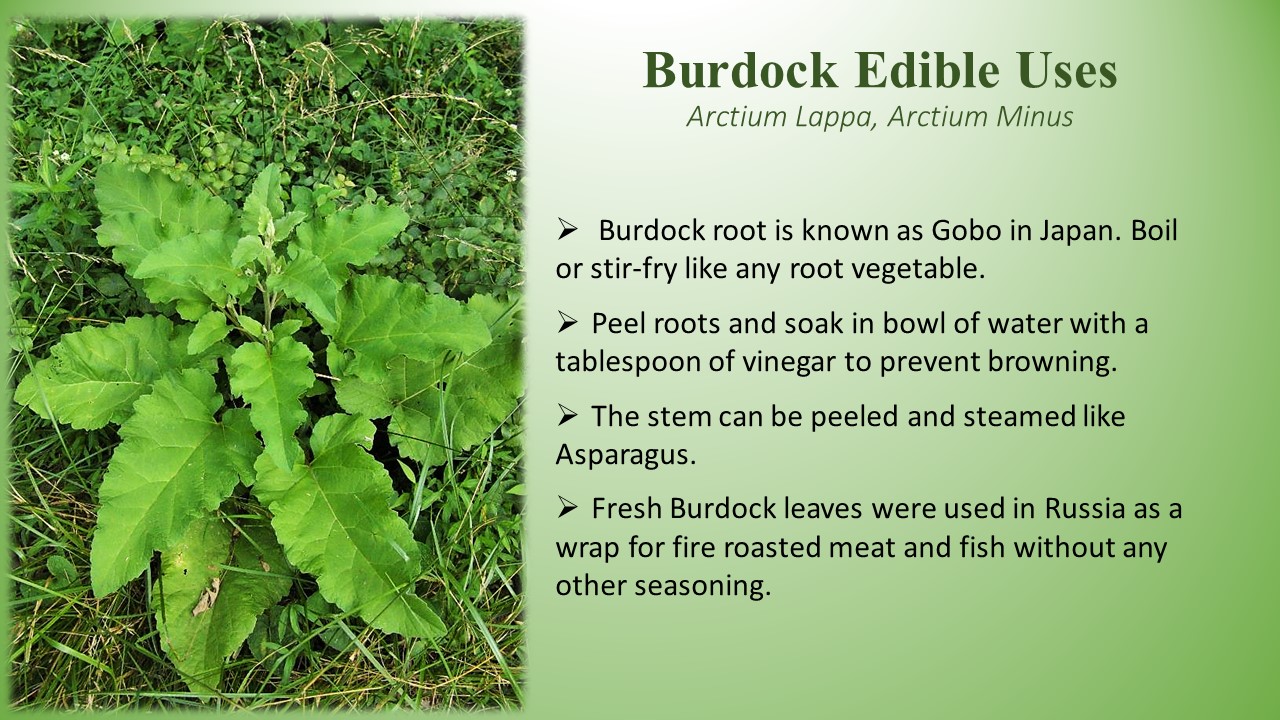
Burdock Herb Use
An old time herbalist, now deceased, told me that the seeds of Cocklebur soaked in milk will cure cancer. The root is edible, and mostly used as a blood purifier; the leaf is used externally for skin breakouts. Burdock has recently been found to be effective against acne breakouts. It is also said that Burdock leaves applied to the feet may cure gout. John Lust in The Herb Book says that Burdock leaves may be helpful as a skin wash for acne, poison ivy, and poison oak.
THE BURDOCK. Edited From Culpeper's Herbal (Public Domain)
"They are also called Personata, and Loppy-major, great Burdock and Clod-bur. It is so well known, even by the little boys, who pull off the burs to throw and stick upon each other, that I shall spare to write any description of it.
Burdock plants grow plentifully by ditches and water-sides, and by the highways almost everywhere through this land.
Government and virtues.
Venus challenges this herb for her own, and by its leaf or seed you may draw the womb which way you please, either upwards by applying it to the crown of the head, in case it falls out; or downwards in fits of the mother, by applying it to the soles of the feet; or if you would stay it in its place, apply it to the navel, and that is one good way to stay the child in it. The Burdock leaves are cooling, moderately drying, and discussing withal, whereby it is good for old ulcers and sores. A dram of the roots taken with Pine kernels, helps them that spit foul, mattery, and bloody phlegm. The leaves applied to the places troubled with the shrinking of the sinews or arteries, gives much ease. The juice of the leaves, or rather the roots themselves, given to drink with old wine, doth wonderfully help the biting of any serpents: And the root beaten with a little salt, and laid on the place, suddenly eases the pain thereof, and helps those that are bit by a mad dog. The juice of the leaves being drank with honey, provokes urine, and remedies the pain of the bladder. The seed being drank in wine forty days together, doth wonderfully help the sciatica. The leaves bruised with the white of an egg, and applied to any place burnt with fire, takes out the fire, gives sudden ease, and heals it up afterwards. The decoction of them fomented on any fretting sore, or canker, stays the corroding quality, which must be afterwards anointed with an ointment made of the same liquor, hog’s-grease, nitre, and vinegar boiled together. The roots may be preserved with sugar, and taken fasting, or at other times, for the same purposes, and for consumptions, the stone, and the lask. The seed is much commended to break the stone, and cause it to be expelled by urine, and is often used with other seeds and things to that purpose."
More Burdock Herbal Use Information
Natural Arctium lappa fruit extract improves the clinical signs of aging skin.Burdock: The Annoying Weed That Can Save Your Life
Burdock Use in Alternative Medicine
Burdock Information from Drugs.com
Observational study of Arctium lappa in the treatment of acne vulgaris.
Effect of Dose and Timing of Burdock ( Arctium lappa) Root Intake on Intestinal Microbiota of Mice
Burdock Folklore and Magical Use
In magic, this is a protective herb that wards off negativity, offers healing and protection.
Sources
Author's own anecdotes - Karen Bergeron
Cunningham's Encyclopedia of Magical Herbs, Scott Cunningham
The Herb Book, John Lust
Peterson's Field Guide to Eastern/Central Medicinal Plants Steven Foster/ James A Duke, PhD
The Project Gutenberg EBook of The Complete Herbal, by Nicholas Culpeper
Next > Butterfly weed