St. John's Wort
St. John's Wort Herbal Use
There are 400 species of St. John's Wort found throughout the world. It has been used as a herbal remedy for thousands of years, but has only been studied for its medicinal value since the latter part of the last century.
St. John's Wort has proven to have many highly active compounds including rutin, pectin, choline, sitosterol, hypericin and pseudohypericin. The flowers and leaves are used in herbalism as analgesic, antiseptic, antispasmodic, aromatic, astringent, cholagogue, digestive, diuretic, expectorant, nervine, resolvent, sedative, stimulant, vermifuge and vulnerary.
The mechanism by which St. John's Wort acts as an antidepressant is not fully understood. Early research indicated that it mildly inhibits the enzyme monoamine oxidase (MAO). MAO is responsible for the breakdown of two brain chemicals - serotonin and nor epinephrine. By inhibiting MAO and increasing nor epinephrine, it may exert a mild anti-depressive action. The antidepressant or mood elevating effects of Hypericum perforatum were originally thought to be due solely to hypericin, but hypericin does not act alone, it relies on the complex interplay of many constituents such as xanthones and flavonoids for its antidepressant actions. Hypericum perforatum may also block the receptors that bind serotonin and so maintain normal mood and emotional stability.
Hypericum perforatum is used in treating a wide range of disorders, including pulmonary complaints, bladder problems, diarrhea and nervous depression. It is also very effectual in treating bed wetting in children. It has a sedative and pain reducing effect, and is especially regarded as an herb to use where there are menopausal changes triggering irritability and anxiety. In addition to neuralgic pain, it may ease fibrosistis, sciatica and rheumatic pain. The oil extract of the plant can be taken for stomach ache, colic, intestinal problems, and as an expectorant for the congestion in the lungs.
Externally, a herbal infusion made from the St. John's Wort flowers in olive oil is applied to wounds, sores, burns, ulcers, swellings, cramps, rheumatism, tumors, caked breasts, and other skin problems. It is also valued in the treatment of sunburn and as a cosmetic preparation to the skin.
Persons with fair skin should avoid exposure to strong sunlight and other sources of ultraviolet light, such as tanning beds, while taking St. John's Wort. These individuals may suffer a dermatitis, severe burning, and possibly blistering of the skin. The severity of these effects will depend on the amount of the plant consumed and the length of exposure to sunlight.
Other Names: Spotted St. John's wort, Hypericum, Klamath Weed, Touch-and-heal, Goat weed, Rosin Rose
Caution St. John's Wort may interfere with other medications. Consult your physician before use if you are taking any prescription medications. Can cause problems with certain anesthesia, so notify your physician before surgery if you take St. John's Wort.
St. John's Wort Habitat and Description
St. John's Wort is a perennial herb native to North America and Canada from Nova Scotia, Ontario Quebec south to the United States, eastern states. Found growing in open sunny or partial shady areas, along roadsides in dry, gravelly soils. Cultivation St. John's Wort is easy to grow from seed or root division in spring or autumn, in any well-drained but moisture retentive soil. Succeeds in dry soils, prefers sun or semi-shade.
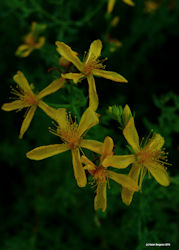
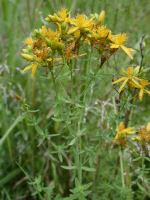
A woody branched root system produces many round, erect, stems branching at the leaf axis, which are covered with dark red dots, stems are solid dark red at base. Growing to a height of 1 to 3 feet, The leaves are opposite, sessile and smooth edged, oblong to linear, light green and smooth, covered with small transparent oil glands that look like holes, more visible when held to bright light. The cymes of yellow flowers, grow atop each stem. The five petals are dotted with black along the margins, the center or ovary is surround by many stamens, causing it to appear furry, flowers bloom from June to September. The fruit is a three celled capsule containing small, dark brown seeds. Gather top 6 to 8 inches of plants when flowers are in bloom, dry for later use.
St. John's Wort Folklore and History
There are many ancient superstitions regarding this plant, its name Hypericum is derived from the Greek and means 'over an apparition,' a reference to the belief that it smelled so obnoxious to evil spirits that a whiff of it would cause them to fly. The plant was given to have magical powers. In ancient Greece, the herb was used to treat many ailments, including sciatica and poisonous reptile bites.
St. John's Wort Recipes
For depression the usual dose is 300 mg 3 times a day. Timed release capsules are now on the market as well. I find it easier to only have to remember to take it once a day. Effects should be felt within a few weeks.
Herb tea: Pour 1 cup of boiling water over l-2 teaspoonfuls of the dried herb and steep for 10-15 minutes. This should be drunk three times a day.
Oil: Fill a pint jar loosely with dried herb, poor olive oil to top, seal tightly and allow to infuse for 4 to 5 weeks, shaking the jar occasionally.
See the Herbal Library for more articles about St. John's Wort
Article by Deb Jackson & Karen Bergeron
Disclaimer
The herbal information on this web site is intended for educational purposes only. It is not the intention of the editor to advise on health care. Please see a medical professional about any health concerns you have. These statements have not been evaluated by the FDA. The information on this web site is not intended to prevent, diagnose, treat, or cure any disease.